
Calorie & macro calculator.
Honest numbers, the way we’d write them on a piece of paper for a client sitting across the counter. No vanity defaults. No padded protein. Just a starting point you can actually use.
Choose your sex.
Body fat distribution and baseline metabolic rate differ between men and women. The chart and the math both adjust for it.
What do you weigh?
Use a morning weight, after the bathroom and before food or drink. If you fluctuate a lot, take a seven-day average.
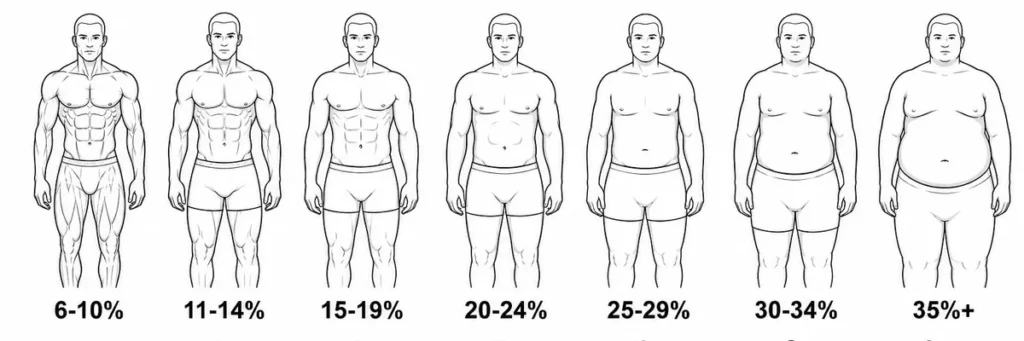
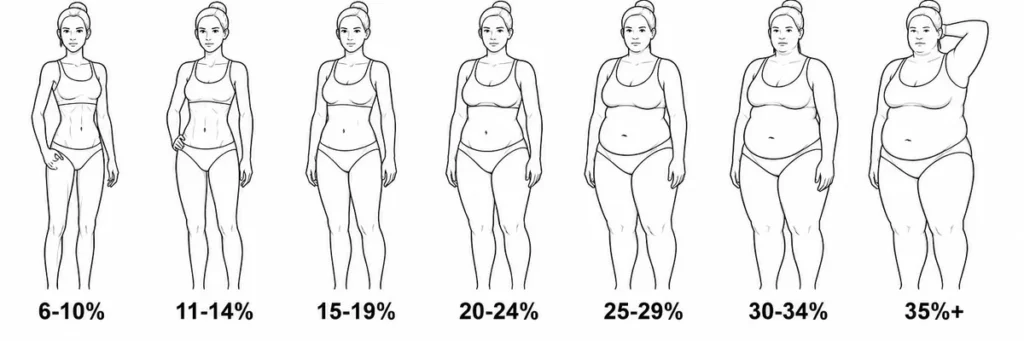
Pick the figure that looks most like you.
Most people don’t know their exact body fat percentage. That’s fine. Pick the figure that matches honestly and we’ll handle the rest. Anchoring protein to lean mass instead of total bodyweight gives a more accurate target, especially if you have weight to lose.
Heads up. Without a body fat estimate, protein and calories are scaled to total bodyweight using the Mifflin-St Jeor equation. Reasonable for most people, but if you have a lot of fat to lose, the protein target will land higher than it needs to be.
Tap the figure closest to your current physique. Between two figures, pick the higher one.
Selected:
How active are you, honestly?
Pick from a seven-day average, not your best week. Most people overestimate this by one level. Be conservative.
What are you trying to do?
Pick one. You can shift later. Most goals work best when you hold the same target for at least three weeks before adjusting.
Here’s your starting point.
Use these as a baseline. Hold them steady for two to three weeks, watch the scale and how you feel, then adjust if needed.
Almost there. A few inputs are still missing.
We’ve hit the 1,500-calorie floor.
The math would otherwise land below 1,500 kcal a day. We don’t recommend severe caloric deficits. They’re hard to sustain, hard to do safely, and almost never the right answer long term. If you genuinely need to eat this low, work with a registered dietitian or physician rather than a free calculator.
Carb & fat preference
Some people feel better with more carbs and less fat. Others go the other way. Slide to taste. Protein stays locked, and fat won’t drop below the safe floor for hormonal health.
We show our work.
Most calculators hand you a number and hope you don’t ask questions. Every equation and constant in this one is laid out below, with the reasoning.
How we did the math.
Most calculators online use one equation, one protein number, and one activity multiplier. That’s fine until you’re trying to feed a real person. Here’s how this one decides what to tell you.
The equation depends on what you tell us.
If you give us a body fat estimate, we use the Katch-McArdle equation, which calculates your basal metabolic rate (BMR) from lean mass rather than total bodyweight. This is more accurate for anyone outside the average: leaner, heavier, more muscular, or higher body fat. If you skip the estimate, we fall back to Mifflin-St Jeor, the most accurate general-population equation we have. Harris-Benedict, the original and the one most calculators still use, is over a hundred years old and runs about 5% high, so we don’t use it.
TDEE is BMR times your activity level.
Sedentary multiplies your BMR by 1.2. Lightly active is 1.375. Moderately active is 1.55. Very active is 1.725. These are the standard, well-validated activity factors. The biggest mistake here is overestimating. Pick the bracket that matches your actual seven-day average, not your best week.
Protein scales with lean mass, activity, and goal.
Your protein target is calculated against lean body mass if you provided a body fat estimate, or total weight if you didn’t, then scaled by your activity level and whether you’re in a fat loss phase. At maintenance or in a surplus, protein runs 0.7 g/lb for sedentary up to 1.0 g/lb for very active. In a fat loss phase we push these to 0.9 to 1.2 g/lb. Protein needs are genuinely higher in a deficit, both for muscle preservation and for satiety, which is one of the biggest predictors of whether someone sticks to a cut.
Anchoring protein to lean mass means a 250-pound person isn’t told to eat 250 grams of protein when 160 would do the job better.
Fat has a floor.
Fat is calculated as either 0.3 g per pound of total bodyweight or 20% of your target calories, whichever is higher. This protects hormonal function, especially in a deficit. The carb and fat slider lets you shift toward one or the other, but the floor stays put.
Carbs are the remainder.
After protein and fat are accounted for, the remaining calories go to carbohydrate. This is intentional: carbs are the most flexible macronutrient for performance, recovery, and adherence, so they absorb the variation.
Fibre scales with intake.
We use the Institute of Medicine recommendation of 14 grams of fibre per 1,000 calories eaten, rounded up to the nearest gram. That’s more accurate than a flat number: a 1,500-calorie cut and a 3,000-calorie bulk shouldn’t share a fibre target.
There’s a hard floor at 1,500 calories.
If the math produces a target below 1,500 calories a day, we cap it there and show a warning. Very low calorie diets are hard to do safely on your own. They make nutrient adequacy nearly impossible, they accelerate lean mass loss, and they almost always backfire on adherence. If you genuinely need to eat this low, work with a registered dietitian or physician.
How to actually use this.
- Weigh yourself in the morning, after the bathroom, before food or drink. If you fluctuate a lot day to day, take a seven-day average and use that.
- Be honest about activity level. Most people pick one bracket too high. If you sit at a desk all day and lift three times a week, you’re lightly active, not moderately active.
- Pick your body fat range honestly. The chart isn’t a contest. Picking the figure that looks most like you, even if it’s heavier than you’d like, produces more accurate numbers. Between two figures, pick the higher one. Conservative beats optimistic.
- Hold the target for at least two to three weeks before adjusting. Weight fluctuates day to day; you can’t read a trend in less than two weeks.
- If you’re losing more than 1% of bodyweight a week consistently, you’re cutting too hard. If you’re gaining more than 0.5% a week and your goal is lean gain, you’re bulking too hard. Adjust calories by 100 to 200 either direction.
- Use the carb and fat slider to match your preference, not the latest trend. Both work. The best macro split is the one you’ll actually stick to.
A few things to be clear about.
This calculator is a starting point, not a prescription. It’s built on well-validated equations, but it cannot account for medical conditions, medications, hormone status, age-related changes, eating disorder history, pregnancy, or any of the dozens of variables that affect how your body actually responds to food.
Nothing here is medical advice. If you have a medical condition, are pregnant or breastfeeding, have a history of disordered eating, or are considering an aggressive cut, talk to a registered dietitian or physician before changing your diet.
If you use the numbers, watch how you feel, and adjust honestly, this calculator will get you most of the way there. If you don’t, no calculator can save you.
All the tools → Rather have a person run it with you? →