
Nutrition coaching that ends.
Lose the weight in four to six months, without a food scale, without Sunday meal prep, and without cooking a second dinner for the kids. Then keep it off without me.
Twenty minutes, no pitch. If I’m not the right fit for you, I’ll say so on the call and point you somewhere better.
You’ve already tried the list.
Keto. Fasting windows. A six-week boot camp. Four gym sessions a week for the better part of a year. MyFitnessPal, for about eleven days.
Some of it probably worked, for a while. That’s the part worth paying attention to: not that it failed, but when. Almost nobody quits in week one. They quit in week three, on a Tuesday, at 6:40pm.
Why week three.
Keto doesn’t work because of ketones. It works because it has rules. Bread, no. Chicken, yes. Two rules, and you never have to think, so it survives a bad day.
A balanced diet asks the opposite of you. How much chicken. Is that too much rice. Does the oil count. What about the kids’ pasta. Thirty small decisions before dinner is even plated, and you’re making them at the end of a nine-hour day and a drive to the field, using the one resource you’ve already spent.
That’s decision fatigue. It is the actual mechanism behind almost every diet you’ve abandoned, and willpower doesn’t fix it, because willpower is the thing that ran out.
So the job isn’t more discipline. It’s fewer decisions, without going back to a list of foods you’re banned from.
The Scoop System.
We start with the food you already eat
At intake I ask for the five meals you eat most often. Not the five you think you should eat. The five that are actually on rotation. Then I rebuild them inside the system at portions calculated for you.
You are a creature of habit and that’s an advantage, not a flaw. Most programs spend week one deleting every habit you have. This one keeps them and adjusts the amounts.
A food list, not a diet
You get proteins, carbs, fats, and a fourth column: foods you can eat as much of as you want, no measuring, no limit.
Building a meal is one decision, four times a day. One protein. One carb. One fat. As much as you like off the unlimited list. Three meals and a snack.
Nothing is banned. If a food is on your list, it’s in.
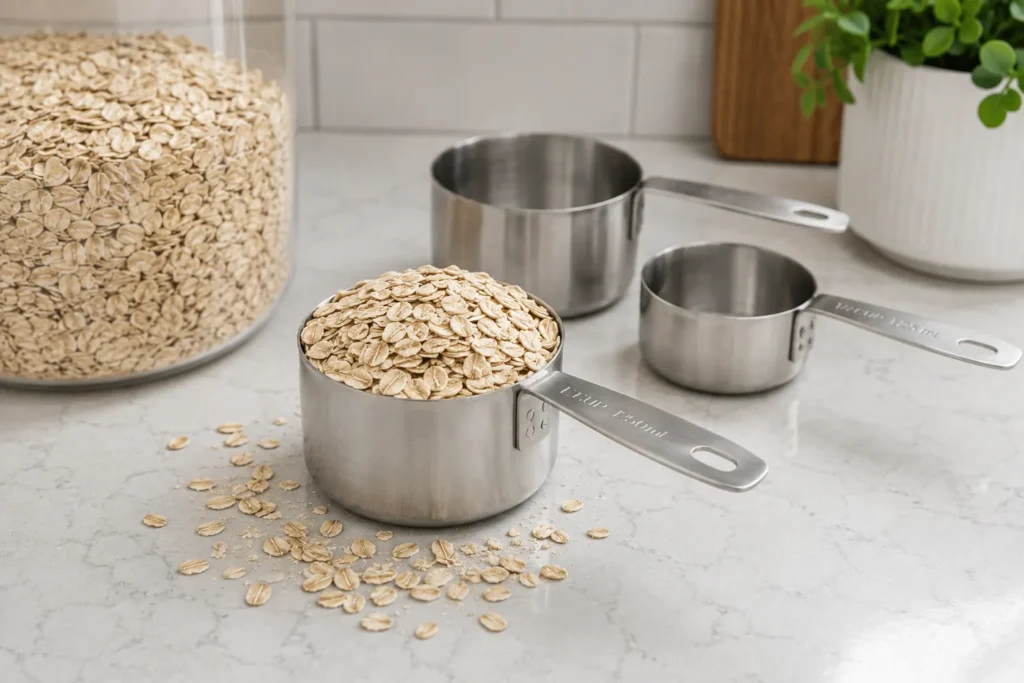
Measuring cups instead of a scale
Every food on your list is written in volume, not grams. Your measuring cups become scoops. No scale, no app, no logging, no arithmetic at the counter.
Here’s the honest limitation: measuring by volume is not precise. A cup of rice varies. But it’s consistently imprecise, the same for you this week as it was last week, and consistency is the only property the system actually needs. Precision is what the check-in is for.
Prep ingredients, not meals
Nobody wants a fridge full of grey chicken in identical containers. That’s why Sunday meal prep collapses by Wednesday.
Instead you prep components. Protein cooked. Potatoes or rice cooked. Vegetables cut. Then dinner is: scoop what the sheet says, into a pan, done. Under fifteen minutes, cooked fresh, and the whole family eats the same meal. Theirs just isn’t measured.
One dial, turned weekly.
Every week we look at your numbers. If the scale isn’t moving, I change a scoop size, usually a carb. That’s the entire intervention.
No restarting. No new plan. No detox week. No being told to try harder. One dial, adjusted slightly, every week, until you arrive.
Then you graduate.
When you hit your goal, I don’t taper you off and hope. I walk your portions back up to maintenance deliberately, so you learn what maintenance feels like while someone is still watching.
Then you get the graduation package: your serving sizes for life, how to adjust them up or down when your job or your body or your season changes, and enough nutrition education to answer your own questions from then on.
Most clients are done in four to six months.
That’s the product. Every other coach is trying to keep you on the roster. At two hundred dollars a month, a coach you never leave costs you twelve thousand dollars over five years, and you still can’t feed yourself without them. I’d rather charge more, for less time, and have you leave.
What you get.
Your results are yours, not my marketing.
You’ll notice there are no before-and-after photos on this page. That’s deliberate.
A lot of coaching contracts require them. Progress photos, update photos, a testimonial at the end, written in as a condition of working together. You pay for the help, and photographs of your body are part of what you pay with. Then they turn up in someone’s ads.
Nothing here works that way. Photos and testimonials are never required, never written into the agreement, and never priced in. What happens to your body is your business. If you finish and decide you want to say something because the work was good, I’ll be grateful for it. But it’s yours to offer, not mine to collect. That’s the same discretion you get on every call, in every check-in, and after you’ve graduated and stopped paying me.
So instead, here’s what I can tell you plainly.
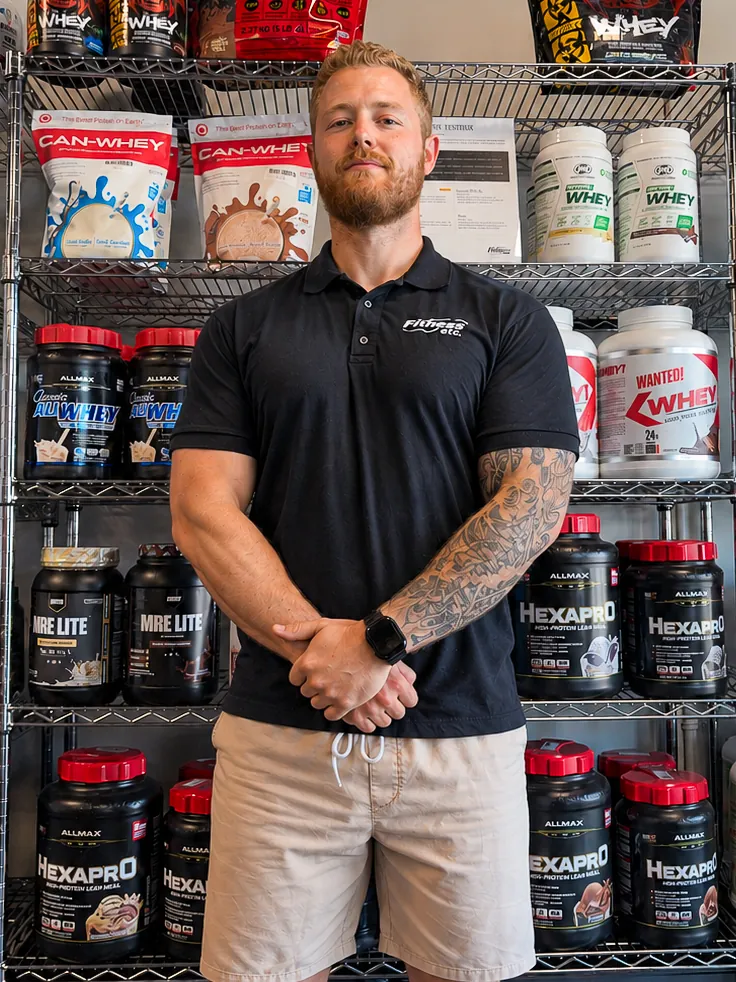
Certified nutrition coach. Over a decade of practice, more than a hundred clients one-on-one.
The typical nutrition result is around 20 pounds lost and kept off. The second half of that sentence is the part I care about and the part most programs never measure.
Clients who also lift commonly double or triple their strength over a coaching term. The lifting is optional, never required.
One client, Elise, gave me permission to share hers. Inside a year she went from being uncomfortable going up and down her own stairs to more than forty pounds down and roughly five times stronger. That’s an outlier and I’ll call it one. Don’t sign up expecting it.
The system is built on behavioural psychology: habit anchoring, decision-load reduction, environment design. It has been reviewed by a colleague holding a psychology degree from VIU.
The graduation guarantee.
Do the work and it doesn’t work, and I coach you free until it does. Or I refund every dollar. Your call, not mine.
“The work” isn’t vague, because a vague guarantee protects nobody:
Do those three things for ninety days without progress and the guarantee is yours. Skip half your check-ins and it isn’t. I’ll have told you that on the call, before you paid, not after.
Don’t book a call if.
You want to be thirty pounds down for a wedding in six weeks. This isn’t fast, and I’d rather say so now.
You want someone to hand you meals. This is a program that teaches you; you’ll be doing the cooking, even if it’s fifteen minutes of it.
You aren’t willing to commit three months. Below that, nothing has time to become a habit and you’d be paying me for a plan you won’t keep.
You want a coach permanently. I’m designed to be temporary. If you like having someone in your corner forever, hire someone who sells that.
You’re looking for the cheapest option. There are apps at fifteen dollars a month. Some of them are fine. They are not this.
What it costs.
three-month minimum
Most clients graduate somewhere between four and six months, which puts the whole thing at $1,600 to $2,400, once, and then you’re done paying anyone.
The three-month minimum exists because months one and two are where the habits get built and month three is where they hold without me pushing. Anything shorter and I’d be selling you a document.
I coach 15 people at a time. That’s a ceiling, not a promotion. At sixteen I do worse work and everyone already on the roster pays for it, so when it’s full I run a waitlist and tell you honestly how long it is.
Book a call with NickQuestions people actually ask.
Do I have to give up bread, pasta, wine, dessert?
No. Nothing is banned. Foods you like appear on your list with an amount beside them. A program you resent is a program you quit.
Do I have to join a gym?
No. The nutrition system works on its own. If you do train, we’ll build around it, and that’s usually where the strength numbers come from.
Do I have to cook separate meals for my family?
No. This is the whole point of the design. Everyone eats the same food. Yours is the only plate that gets scooped.
What about restaurants and travel?
You’ll learn to estimate from the same food list, which is why the education matters more than the plan. Nobody graduates who can’t handle a Friday out.
Isn’t measuring by volume inaccurate?
Yes, and it doesn’t matter. It’s consistently inaccurate, so week-over-week comparison still works, and I adjust from your results rather than from a theoretical number. Precision you can’t sustain is worth less than approximation you can.
I’m on a GLP-1 medication. Does this work?
It’s a good fit. The main clinical concern on those medications is losing muscle alongside fat, which comes down to hitting protein consistently and training. Both are already the backbone of this system. Bring it up on the call.
What actually happens at a check-in?
You send your numbers, I read the trend, and I tell you which scoop changes. Usually a two-minute answer. That’s what a system running properly looks like.
How does it end?
Deliberately. Portions come back up to maintenance while you’re still being coached, then you get the graduation package and you’re on your own, on purpose.
Book a call.
Twenty minutes. Tell me what you’ve tried and what got in the way, and I’ll tell you straight whether this fits, including if it doesn’t.